

JACKSONVILLE, Fla. – As questions continue surrounding unredacted versions text messages released in the investigation into Former Jacksonville City Council President Kevin Carrico’s communications regarding a JEA board appointment, a First Amendment attorney said the case highlights the importance of Florida’s public records laws and raises broader questions about how government records are reviewed and disclosed.
Ed Birk, a media attorney specializing in First Amendment and open government law, said whether a text message is considered a public record depends on its content — not whether it was sent from a personal cellphone or a government-issued device.
Recommended Videos
“Generally, the law is that the device doesn’t matter so much as the content of the messages,” Birk said. “If it’s business-related or government-related content, then those are public records, even if it’s on a personal phone.”
The comments came after the State Attorney’s Office released records related to its investigation of Carrico, following the councilman’s use of the phrase “big favor” in relation to a JEA board appointment.
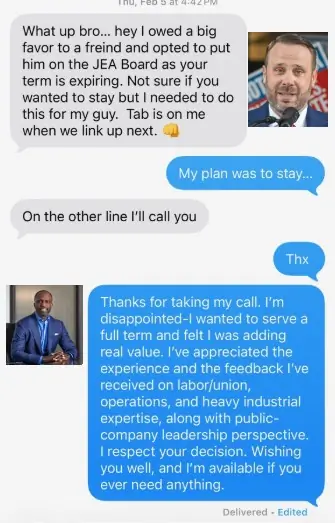
Investigations have since grown to examine a potential land deal in Nassau County. The state attorney’s office had obtained the records through a subpoena sent to Carrico in the spring.
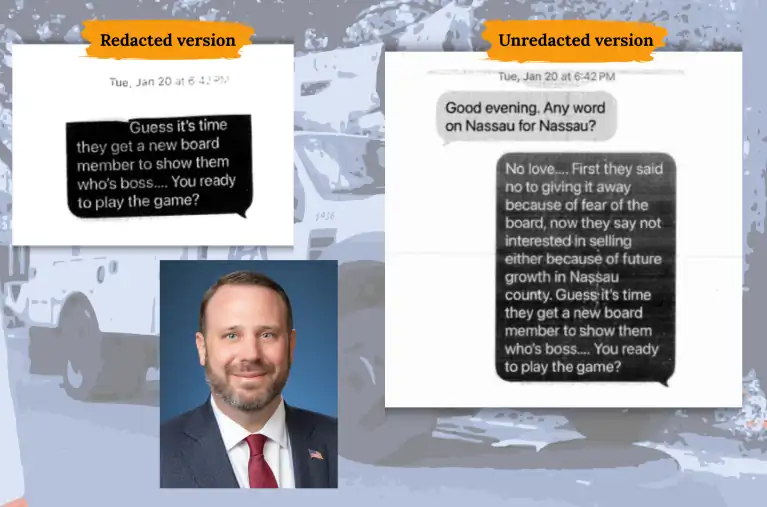
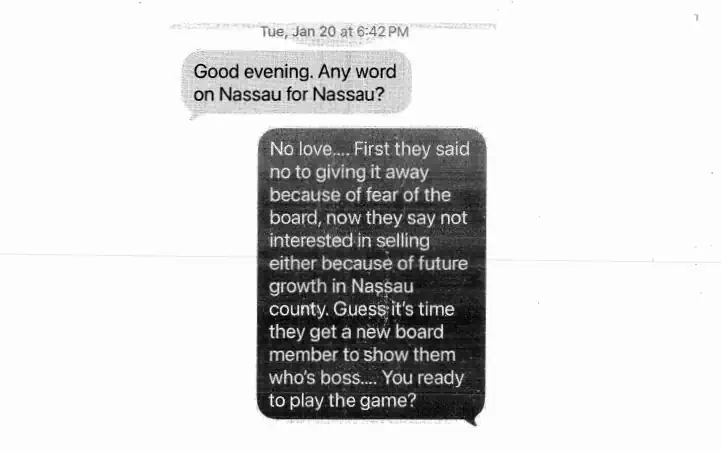
When the City Council initially released the messages in response to public records requests, portions of the texts were redacted as personal. The versions later produced by the State Attorney’s Office included additional, previously withheld content.
In an email to our partners at the Florida Trib explaining the differences, Jason Teal, the city council director and legislative counsel, said Carrico personally reviewed the records and separated public communications from private ones.
According to Teal, the redacted portion of one text conversation involved Carrico’s role as a private employee of the Boys & Girls Clubs of Northeast Florida discussing a project in Nassau County involving another private organization.
“However, it switched once it crossed into the Council President’s ability to introduce legislation for an appointment to the JEA Board,” Teal wrote. “Hence the reason that that portion of the text was provided as the public record.”
Birk said determining whether information is exempt from disclosure requires reviewing the substance of each message individually.
“There may be some personal details in the text, but if it pertains to any sort of official responsibilities or government action, then that’s going to be deemed as government-related,” he said.
Different custodians can reach different conclusions
Birk said it is possible for different government agencies to make different decisions about what should be redacted.
In this case, the City Council and the State Attorney’s Office each reviewed the records independently.
Still, Birk said the release of the previously redacted messages naturally raises questions.
“The sequence and the content of these messages suggests that the City Council might have been too quick to deem something personal,” Birk said. “Maybe to avoid embarrassing content. Maybe not, but that certainly raises the suspicion.”
He noted that under Florida law, any agency withholding or redacting records must cite the specific legal exemption authorizing the redaction.
Birk praised the State Attorney’s Office for providing a detailed exemption log explaining each redaction and the statutory basis for withholding information.
If someone believes records were improperly redacted, Birk said the proper avenue is to challenge the decision in court, where a judge can privately review the records and determine whether the exemptions were properly applied.
Transparency is essential
Birk said Florida’s broad public records laws are designed to ensure citizens can monitor how government officials make decisions and spend taxpayer dollars.
“Our whole system of democracy depends upon the voters and the citizens being fully informed about what our government is doing on our behalf,” he said.
He said delays in obtaining records or high costs associated with public records requests can undermine that goal.
“When there are roadblocks or hurdles to getting that information, either delays in time or delays because of huge costs, then the public is not served by that,” Birk said.
News4JAX previously reported that the City Council estimated it would cost approximately $4,000 to fulfill the public records request related to Carrico’s records that were turned over to investigators. After attorneys for News4JAX and several other local media outlets got involved, the estimate was reduced to around $200.
Investigation continues
Birk cautioned against drawing conclusions before the investigation is complete but said the newly released communications are one possible interpretation investigators will likely examine.
“I’m glad the state attorney is investigating it,” he said. “We have to wait and see what conclusion she draws.”
He added that maintaining public confidence in government institutions depends on thorough investigations and meaningful public access to records.
“This is what we need from our state attorney and from others who have that responsibility,” Birk said. “Public confidence in our institutions is crucial.”
The State Attorney’s Office has not announced whether it plans to file any charges in connection with the investigation.
