

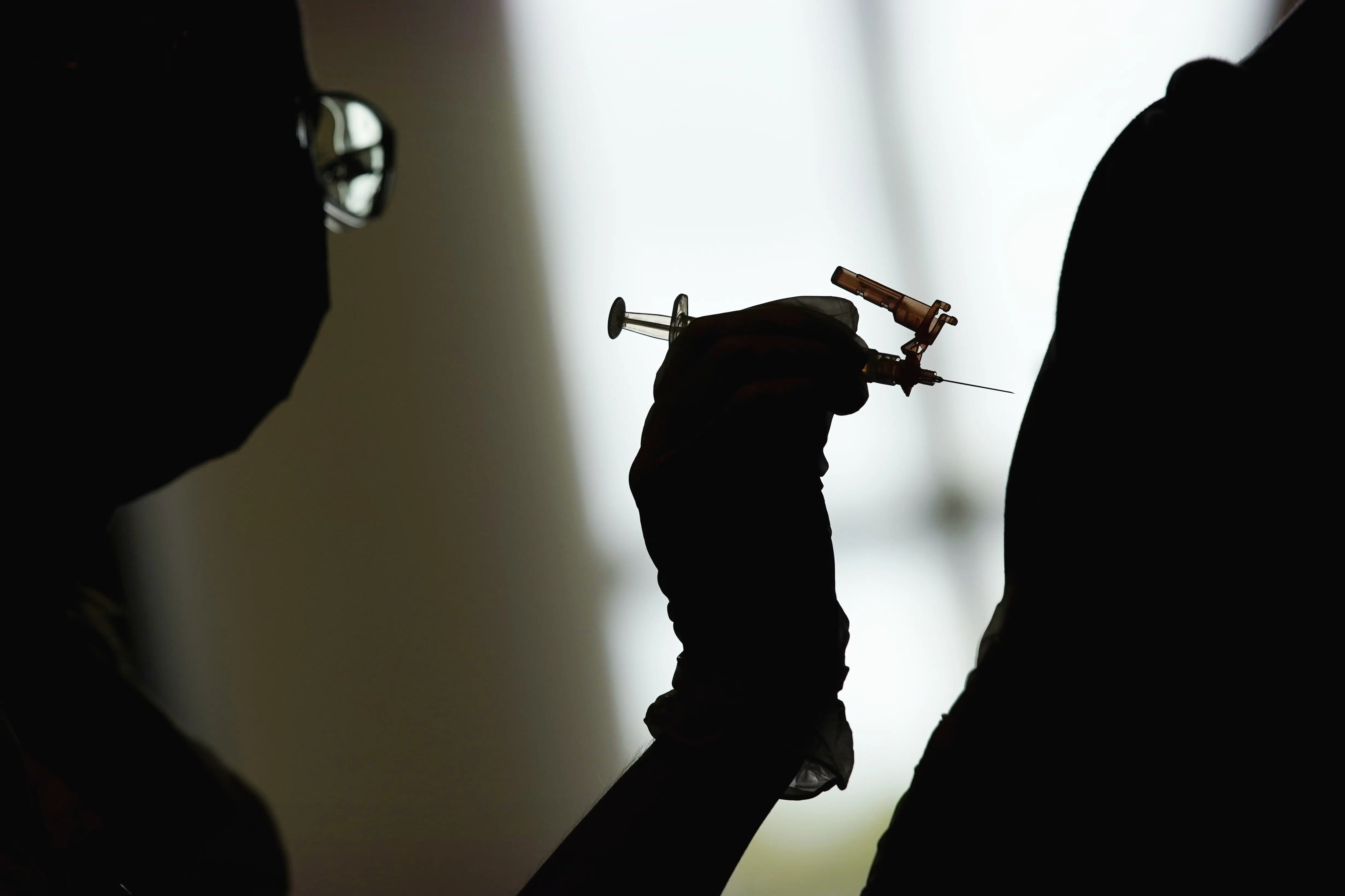
For months, Maria Cristina was hesitant about getting a COVID-19 vaccine. Her fears came from social media, where she heard ample amounts of misinformation about what was in the vaccine and what it could do to her.
The 35-year-old Guatemalan immigrant was confused until the day she called the local Latino Community Center in Pittsburgh to ask how she could better protect herself and her four kids, one of whom has cancer. A staffer there encouraged her to get vaccinated and shared with her a story about how COVID-19 affected one family: everyone in the family got the virus, they told her, except for one person — the one who was vaccinated. Cristina says that story helped her decide to take the shot.
Recommended Videos
“It’s the best decision to make to protect your family,” she said.
Philanthropies hope to replicate stories like Cristina's by pouring millions into programs aiming to persuade vaccine-hesitant Americans to get the shots. Most new infections of the virus are among unvaccinated Americans — nearly 23% of all U.S. adults. They've refused to budge, despite pleas from officials and offers of lottery prizes and other gifts.
The center that helped Cristina make her decision is one of the more than 150 community-based organizations funded by the CDC Foundation, a charity created by Congress in 1992 to help the Centers for Disease Control and Prevention advance its mission. Since June, it has pushed $32.7 million into local organizations in 38 states to promote the shots.
A large chunk of the money came from the CDC itself. Private donors, including Google’s charitable arm and other foundations have also contributed, but fundraising hasn't been easy. The CDC Foundation doesn’t have an endowment so it depends on donors, many of whom stopped giving when case numbers fell in late spring and early summer, said Judy Monroe, the foundation’s CEO and president. The group has been scrambling to get more resources to areas with high virus infection rates as case numbers climbed back up.
“We need to reach those communities really quickly,” Monroe said.
When misinformation swept through some conservative circles, the Helmsley Charitable Trust began running TV and radio ads in rural counties across seven states encouraging people to take the shot. Two of its targets — North Dakota and Wyoming — have some of the lowest vaccination rates in the country.
“Unfortunately, it’s been so politicized and we’re seeing politics come into something that’s a public health decision,” said Walter Panzirer, a Helmsley trustee and the grandson of Leona Helmsley, the late hotel magnate who established the charity.
“I’ve heard many people in rural America say that they don’t want their daughters to get the shots because they’re worried about fertility problems -- truly misinformation,” Panzirer said. “So we’re trying to correct that... and really tell the story that it is a safe and effective shot.”
More than $1 million has been spent on these ads, one of which shows vaccinated people having a good time eating at restaurants and going to a concert. Another one asks Americans to get vaccinated so “heroes,” like doctors and other frontline workers, can avoid a big, variant-induced health crisis.
Foundations are taking different approaches since there’s no recipe for getting someone to change their mind on this issue. However, a July report released by the Kaiser Family Foundation shows conversations with family and friends have played a major role in changing attitudes. It found 17% of adults who, in January, were vaccine-hesitant — saying they either did not want to get the shot, wanted to wait or said would only do it if it was required — were persuaded to get vaccinated by a family member. Five percent say they were persuaded by a friend.
Christienne Alexander, a medical doctor who teaches at Florida State University’s College of Medicine, says sometimes, the best approach is a simple conversation where the person is given accurate information and space to think about what was said. And then, revisiting the topic later.
Those conversations are happening in the Bronx, where the group Bronx Rising Initiative begins a typical day on their street outreach program by stationing their van in highly concentrated areas of the New York City borough. Then, they walk around, asking anyone they find if they're vaccinated, or not.
Their conversations typically begin with street vendors, said Jason Autar, the group’s chief operating officer. He often listens as some people express their fears and worries about the vaccine, some of which comes from misinformation spread on social media. He then attempts to poke holes in their argument, and offer them a $50 or $100 gift card as an incentive to get the shot, which could be administered on the spot.
“It ultimately comes down to trust, and what institutions they’re going to trust,” Autar said. “Health care hasn’t necessarily been prioritized in this borough. And then all of a sudden the government is coming in, or institutions are coming in saying ‘you need to get vaccinated’. There’s going to be a disconnect there.”
“This is going to take time,” he added. “There’s not a silver bullet.”
To date, the New York-based nonprofit the Oyate Group has poured $2 million into the initiative, which estimates about 3,000 people have been vaccinated after speaking with a member of their team about the shot. Autar says they've also been partnering with schools and community centers to tap into trusted community messengers during their vaccine outreaches.
The Knight Foundation has also focused on finding trusted voices, giving the city of San Jose, California, $125,000 to hire local social media influencers to dispel vaccine myths. Similar work is being done through grantees of The New York Community Trust and The Rockefeller Foundation, which has poured $33.5 million into virus-related initiatives since April.
About $20 million of that is supporting community-based organizations in five major U.S. cities, aiming to help them tackle misinformation and establish better access to vaccines in communities where historic mistrust in the healthcare system is high. The rest will be used to help dispel confusion globally.
Estelle Willie, the foundation’s director of health policy and communications, says the misinformation-oriented funding is necessary because we don't have the tools to “counter it effectively on a global scale.”
___
An earlier version of this article improperly categorized references to misinformation and has been clarified.
____
The Associated Press receives support from the Lilly Endowment for coverage of philanthropy and nonprofits. The AP is solely responsible for all content. For all of AP’s philanthropy coverage, visit https://apnews.com/hub/philanthropy.