

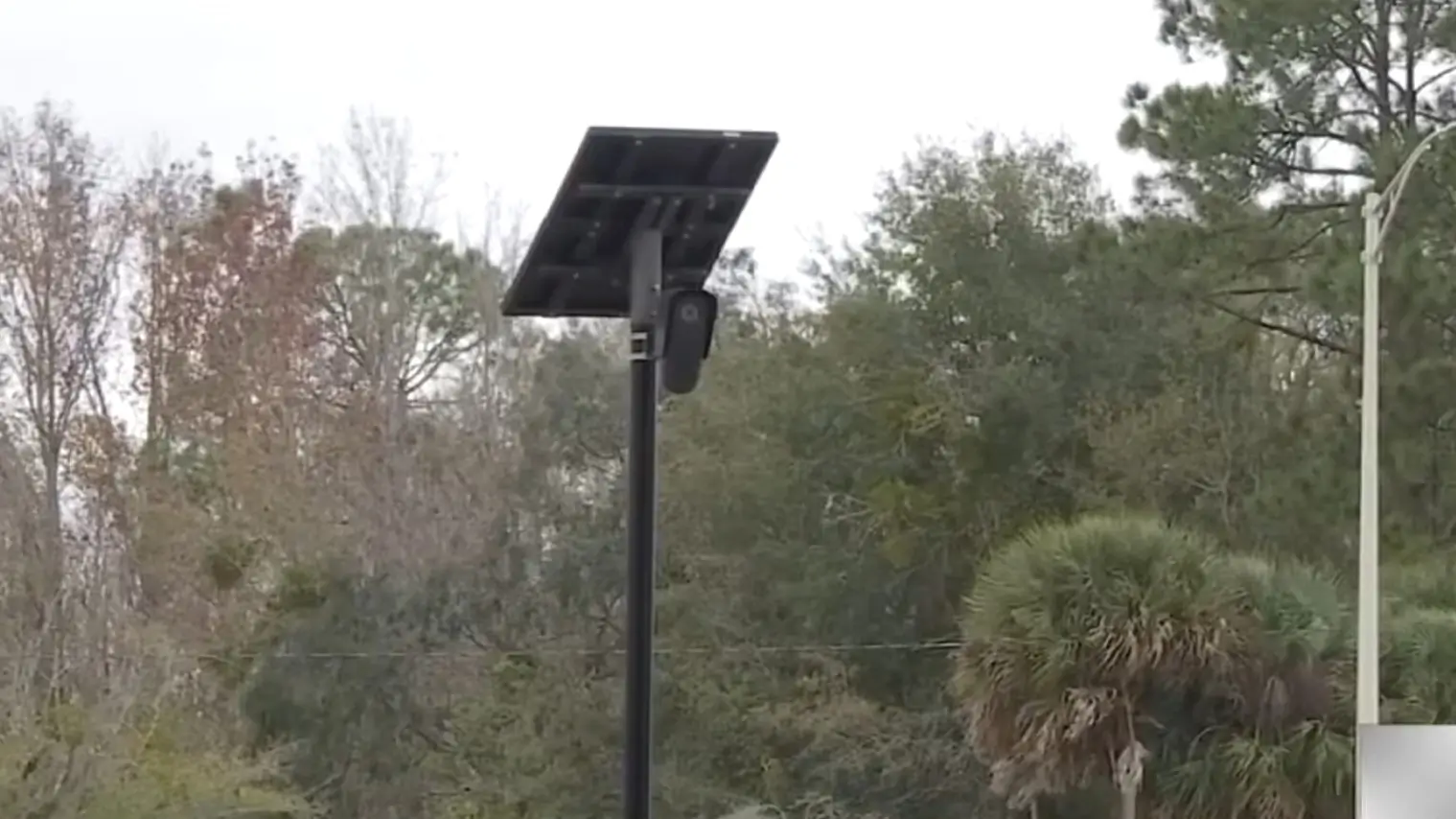
Growing numbers of municipalities and private entities are installing automatic license plate readers to help solve crimes, locate missing people and identify trespassers.
According to reporting by News4JAX sister station WKMG in Orlando, at the same time as these Flock readers are being installed, privacy advocates are creating online maps that reveal the devices’ locations.
Recommended Videos
License plate readers, or LPRs, photograph and electronically log the tag numbers of passing vehicles while potentially using artificial intelligence to collect additional data like the vehicles’ model or color.
A sergeant with the St. Johns County Sheriff’s Office explained to News4JAX earlier this year that the county’s dispatchers and real-time intelligence center get an alert when the LPR flags a license plate associated with a stolen vehicle, missing person or wanted person.
“Utilizing this technology, we’ve solved hundreds and hundreds of property crimes and more violent crimes,” St. Johns County Sgt. Kyle Cubbedge said.
Data from the last two years showed that LPRs had helped find 151 missing persons, recover 597 stolen vehicles, track down 220 wanted people and charge 782 people in St. Johns County.
One notable case involved a Texas man with five warrants who was found in Durbin Village with a missing teen. Thanks to the license plate reader, the teen was saved, and the man was arrested.
In Central Florida, when 13-year-old Madeline Soto was first reported missing in 2024, Kissimmee Police used LPRs to prove her mother’s boyfriend lied about driving the teen to school that morning.
Instead, the LPR data revealed that Stephan Sterns, who was later convicted of raping and murdering Soto, drove his car in the opposite direction of the school.
Information from LPRs and other traffic cameras helped search teams successfully narrow down the location where Soto’s body was found, court records show.
Where are the cameras?
Typically, LPRs manufactured by Flock Safety and other companies can be seen by drivers, but law enforcement agencies don’t necessarily want to advertise their locations.
Mount Dora police, for example, told WKMG that they believe discussions about the placement, usage or operational aspects of public safety tools like LPRs could compromise law enforcement strategies and effectiveness.
That’s where privacy organizations like DeFlock come in.
INTERACTIVE: Check out the DeFlock map below
“I don’t think anybody likes mass surveillance and being watched all the time,” said Ed Vogel, a researcher who works with DeFlock. “I think we need to pause and slow down because a lot of this is being adopted very quickly.”
The DeFlock map shows hundreds of LPRs in Northeast Florida communities like Jacksonville, Orange Park, St. Augustine, Palatka and Gainesville.
In St. Johns County, there were more than 160 license plate reader cameras in January, according to the Sheriff’s Office, and that number was expected to increase after the county was awarded $1 million by the state to enhance its immigration enforcement efforts.
The DeFlock map also shows hundreds of LPRs in Central Florida areas like Orlando, Titusville, Sanford and Ocala, and WKMG independently verified the locations of dozens of cameras plotted on the DeFlock map, including several located in Lake County.
While most of the devices were purchased by government and law enforcement agencies, private companies like retailers and apartment complexes also own LPRs.
Lowe’s Home Improvement uses the technology for security, fraud prevention and asset-protection purposes but will also share data with law enforcement solely in connection with criminal investigations, according to the company’s website.
Privacy concerns
Mount Dora Police told WKMG that “LPRs are not used to monitor law-abiding citizens or track individuals’ daily activities.”
“The technology captures license plate data visible from public roadways and is used in accordance with Florida law, departmental policy, and established data retention and access controls,” the department said in a statement.
In St. Johns County, Cubbedge told News4JAX in January that consistent audits help protect people’s privacy.
“We do a quarterly audit. Anyone who utilizes this system to search has to have an active case number that they’re currently working on as a reason why they would search the database,” Cubbedge said. “And the cameras don’t pick up anything about you or your name or whatnot. There’s no data collection.”
But critics, including the American Civil Liberties Union, have warned that systems like Flock have the potential for abuse and may invade the privacy rights of citizens not suspected of any crimes.
And Vogel thinks citizens have a right to know where LPRs have been deployed and how governments use them.
“Once you really understand their full capabilities, and how much data they’re collecting, who has access to that data, I think it raises a lot of concerns,” said Vogel. “There’s very little democratic conversation happening regarding their use, their adoption, and why the police even need them.”

