

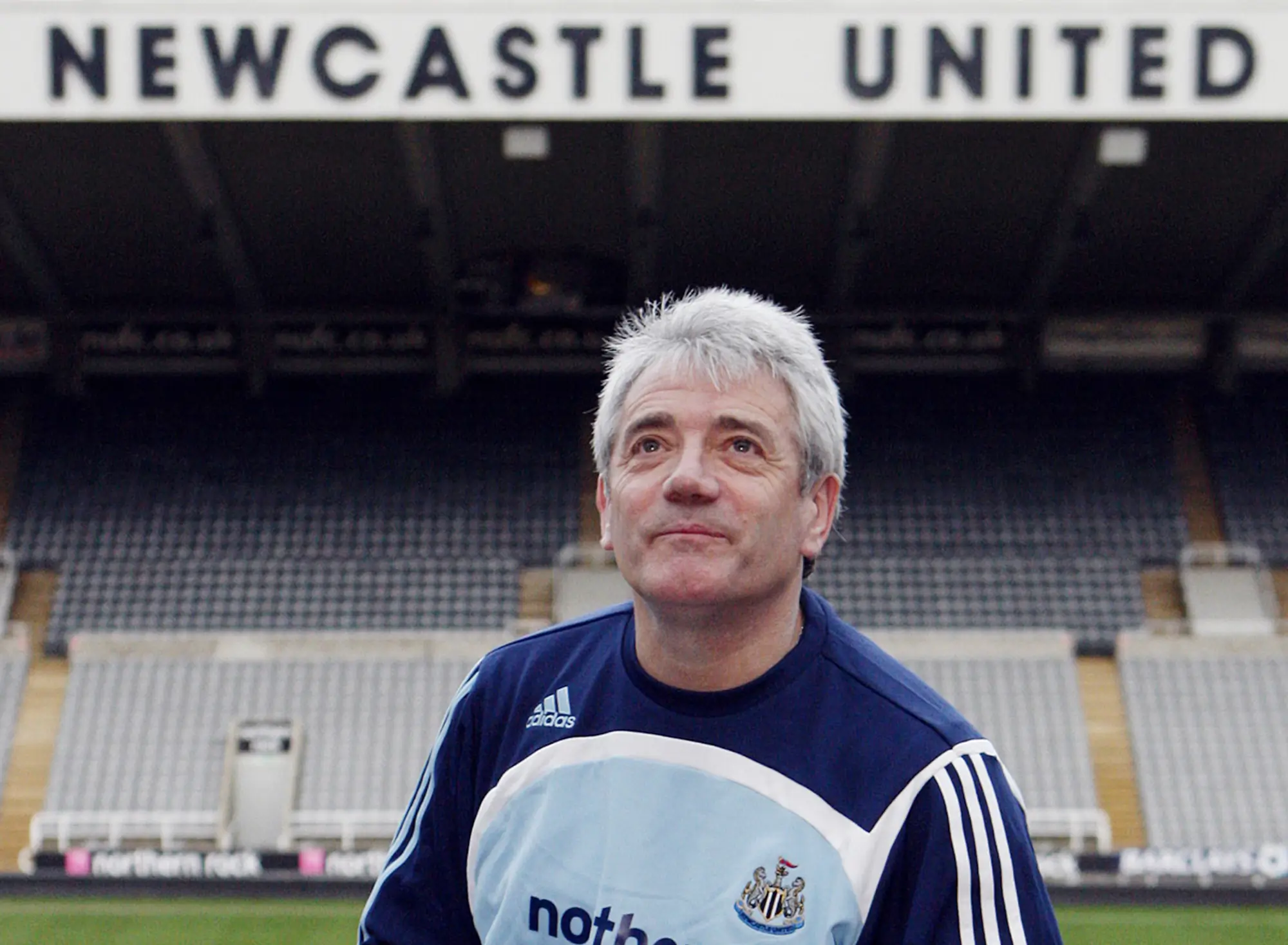

Kevin Keegan, the two-time Ballon d’Or-winning soccer star who captained and coached England and won the European Cup with Liverpool, has died. He was 75.
His death was announced Monday by former club Newcastle, where he had been both a player and coach. Keegan revealed last month that he had stage four cancer.
Recommended Videos
“One of the most iconic, influential and deeply loved figures in our club’s history,” Newcastle said.
For a time in the 1970s, Keegan transcended the English game with his celebrity status.
Keegan, one of just four Englishmen to win the Ballon d’Or, wasn’t just a brilliant soccer player who dovetailed nimbleness and an eye for goal with a relentless hunger and work rate stemming from his working-class upbringing in northern England.
He was also a trendsetter off the field, through his haircut — a perm, which other footballers across Europe started to copy — and his move into celebrity culture that saw him release a single, appear in an after-shave ad with heavyweight boxing great Henry Cooper, and go on TV shows.
Keegan was also something of a trailblazer in his sport as one of the first English players to move to a continental team when he left Liverpool, where he’d just won the European Cup, for German club Hamburger SV in 1977.
“For Hamburg fans he will remain above all a crowd favorite, an exceptional player, and one of the best footballers ever to wear the rhombus (crest) on his chest,” the Bundesliga club said.
It was in Hamburg where Keegan won the Ballon d’Or — then called the European Footballer of the Year award — in 1978 and 1979 and featured in another European Cup final, a 1980 loss to Nottingham Forest.
Keegan scored 21 times in 63 games for England and played at the 1982 World Cup, his only appearance on soccer’s biggest stage after the country failed to qualify in 1974 and 1978.
Coaching career
His 16-year coaching career from 1992-2008 was memorable for almost leading Newcastle, the team where he retired as a player, to the Premier League title in 1995-96, only for a late-season collapse which included Keegan’s unforgettable outburst of “I’d love it if we beat them, love it” in a nod toward Alex Ferguson’s Manchester United — the eventual champion.
He then showed more vulnerability in a 20-month spell in charge of England in 1999 and 2000, during which the team failed to get out of its group at the 2000 European Championship before Keegan resigned after the first game of World Cup qualifying — a 1-0 home loss to Germany in the last game at the old Wembley Stadium.
He announced his departure to Football Association officials in an emotional chat in a toilet cubicle.
Born in Doncaster on Feb. 14, 1951, Keegan first played for fourth-tier Scunthorpe in the English league before joining Liverpool in 1971 and, under iconic manager Bill Shankly, immediately forging a strong on-field relationship with John Toshack in a “big man, little man” strike partnership.
Keegan, 5-feet-8 (1.73 meters) and affectionately nicknamed “Mighty Mouse,” fed off the knockdowns and presence of the tall and slender Toshack.
That combination propelled the Reds to an English league-UEFA Cup double in 1973, and Keegan won two more league titles (1976 and 1977), an FA Cup (1974), another UEFA Cup (1976) when he scored in both legs of the final against Club Brugge, and the big one — the European Cup in 1977 — in a trophy-laden stint at Anfield.
“His legacy at Liverpool will be forever etched in history,” the club said. “He was regarded as a hero wherever he went.”
In that 1977 final, Keegan won the penalty — given after he was fouled by Berti Vogts — that was converted by Phil Neal to seal a 3-1 win over Borussia Mönchengladbach.
Hamburg heights
It was widely reported that Keegan then became European soccer’s highest-paid footballer when he joined Hamburg, whose players were initially resentful of the Englishman arriving on big money. He won them round and captured his first Ballon d’Or in 1978 — despite Hamburg only finishing 10th in the German league in his first season — and then helped the club win the title in 1979, with a reward being another Ballon d’Or.
“Hamburger SV will always cherish the memory of its former championship-winning player and two-time Ballon d’Or winner," the German club said.
Off the field, Keegan’s status soared. That year, he released “Head Over Heels in Love,” which finished higher in the singles’ charts in Germany (No. 10) than in England (No. 31), and opened up his home for a behind-the-scenes documentary following his life.
In his third season at Hamburg, the team lost the European Cup final and the Bundesliga to Bayern Munich, and Keegan returned to England with Southampton. There he was the English league’s top scorer with 30 goals in the 1981-82 season — his second and last at the club before moving to Newcastle, his father’s favorite team.
With his work rate and personality, Keegan was adored at St. James’ Park — setting the seed for his later coaching roles there — until he retired in the summer of 1984, though he did put his boots back on in 1985 for a couple of guest appearances for Australian team Blacktown in the Sydney suburbs.
England star
Keegan was a star player for England from the mid-1970s to the early 1980s, an underwhelming period for the national team when it failed to reach back-to-back World Cups (1974 and 1978) and the 1976 European Championship.
He was the captain for Euro 1980 when England didn’t get out of its group. His sole World Cup appearance came in the 1982 tournament, when he had a back problem and only came on as a second-half substitute in what proved to be the team’s final game.
In a coaching career that began in 1992, Keegan was regarded as tactically limited but a good man-manager — nowhere more so than in his first job at Newcastle, which he led out of the second tier and then almost to the Premier League title in the 1995-96 season.
In February, Newcastle led the league by 12 points and had picked up the nickname of “The Entertainers” under Keegan, but it collapsed in the run-in and was reeled in by Ferguson’s Man United.
In a post-match interview in the final weeks of the season, an emotional Keegan became unhappy at some comments from Ferguson — a master of the so-called “mind games” — and unleashed a finger-pointing outburst that ended with the words: “You can tell him now, we’re still fighting for this title. And he’s got to go to Middlesbrough and get something. And I’ll tell you ... honestly ... I will love it if we beat them, love it.”
Newcastle didn’t, finishing four points behind United in second place.
Either side of the England job, Keegan coached Fulham (1997-99) and Manchester City (2001-05). He also had another brief spell in charge of Newcastle in 2008, resigning after nine months following a breakdown in his relationship with club owner Mike Ashley.
Keegan never coached again but kept in the public eye with TV commentary work.
In early 2026, his family said he had been diagnosed with cancer, and Keegan himself said on stage at a live event a few months later that it was discovered when he had a scan for an operation following his involvement in a car crash.
“They said we have a top doctor with this new way of fighting what you have got, which is stage four cancer,” Keegan said. “He was a Liverpool supporter so I went to meet him. I knew I wouldn’t be walking alone.”
___
AP soccer: https://apnews.com/hub/soccer